

Disclaimer: The medications discussed in this article may include compounded preparations from a licensed 503A compounding pharmacy. Compounded medications have not been reviewed or approved by the FDA and are not the same as commercially available FDA-approved products. This content is for educational purposes only and does not constitute medical advice or establish a provider-patient relationship. Please consult a licensed healthcare provider for personalized clinical guidance.
A patient came to me about eight months ago, a man in his early fifties who had been lifting weights consistently for three decades. He was eating clean, sleeping reasonably well, and his testosterone was within normal range. But he could not hold onto lean mass the way he once had, and he told me recovery after training felt the way it used to feel after overtraining. His IGF-1 came back at 87 ng/mL. That number told most of the story.
When thinking about sermorelin dosage for muscle growth and recovery, it starts here, not with a protocol number, but with understanding what that IGF-1 value represents and why restoring it matters.
What Sermorelin Actually Is and Why It Works Differently From Synthetic HGH
Sermorelin is a 29-amino acid synthetic analogue of growth hormone-releasing hormone, or GHRH. This is the peptide the hypothalamus naturally produces to signal the pituitary to release growth hormone. It does not introduce exogenous growth hormone. It works upstream, stimulating the pituitary to produce and release GH in the pattern it was designed to follow.
The mechanism begins at the somatotroph cells of the anterior pituitary, which express GHRH receptors. These receptors are Gs protein-coupled receptors, meaning when GHRH binds, they activate adenylyl cyclase, which raises intracellular cyclic AMP. The cAMP then activates protein kinase A, which phosphorylates transcription factors that drive GH gene expression. This is not a blunt hormonal override. It is a physiologically embedded signaling pathway that the body already knows how to calibrate.
The pituitary can still modulate the response. Somatostatin counter-regulation, the hypothalamus's natural brake on GH secretion, still applies. Somatostatin inhibits GH release when GH levels are sufficient, ensuring that sermorelin cannot drive GH into pharmacological excess the way exogenous HGH can. This is the critical practical distinction from synthetic HGH, which delivers GH whether the body needs it or not, at levels that can suppress the natural axis over time.
The Standard Dosing Range and Why Timing Matters
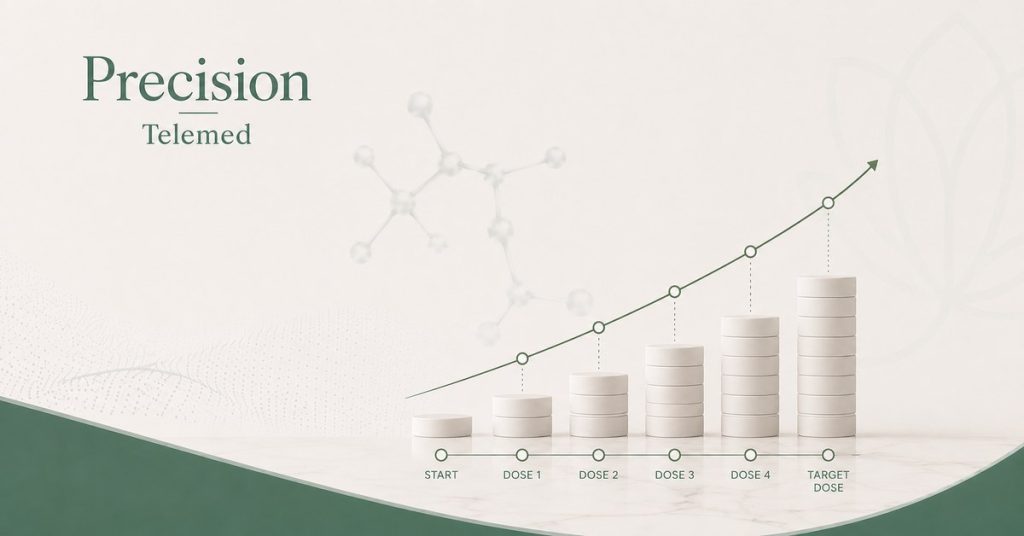
In clinical practice, I dose sermorelin between 200 and 500 micrograms subcutaneously, administered at bedtime. The lower end of that range, 200 to 300 mcg, is appropriate for most patients starting out. I titrate upward based on IGF-1 response at six to eight weeks. Patients who reach the 400 to 500 mcg range and show strong IGF-1 response are generally the ones I keep at a higher dose.
Bedtime dosing is not arbitrary. During waking hours, somatostatin tone is relatively higher, suppressing GH secretion. As the body transitions into slow-wave sleep, somatostatin release falls and GHRH signaling becomes dominant, producing the large nocturnal GH pulse. Administering sermorelin just before this window amplifies a pulse that was already biologically primed to occur.
A 1992 study published in Neuroendocrinology by Steiger and colleagues demonstrated this precisely. Pulsatile GHRH administration increased slow-wave sleep from 14.0 to 20.2 percent of total sleep time, a 44 percent relative increase, alongside elevated nocturnal GH secretion. (PubMed) The fact that GHRH administration increases slow-wave sleep is part of why sermorelin's benefits extend well beyond what a simple "growth hormone booster" framing would suggest.
I use a five nights on, two nights off protocol with most patients. Continuous daily stimulation over long periods can reduce pituitary responsiveness to GHRH signaling, and the brief rest helps preserve receptor sensitivity by working with the somatostatin system rather than against it.
What to Expect in Weeks 1 Through 4
The first changes patients notice are in sleep quality, not in the mirror. Improved sleep, specifically deeper and less fragmented sleep, is the earliest and most consistent feedback I receive from patients in the first two to four weeks. Some report waking up feeling more rested than they have in years.
The Steiger data helps explain this. The 44 percent relative increase in slow-wave sleep fraction is a large shift in architecture. Patients who have been running on fragmented sleep for years are essentially getting a physiological reset in sleep staging. The downstream effects show up as improved mood, reduced afternoon energy crashes, and faster recovery from exercise. These are the early consequences of improved nocturnal GH activity acting through the very mechanism that slow-wave sleep was designed to support.
Body composition changes in week three are not the signal to watch for. That is not how this works.
Months 2 Through 3: Energy and Early Body Composition Changes
By the second month, IGF-1 levels should be rising meaningfully in patients who are responding well. I check IGF-1 at baseline and again at six to eight weeks. The IGF-1 elevation matters because IGF-1 is the primary effector molecule for GH's anabolic actions. After GH stimulates the liver to produce IGF-1, that IGF-1 travels through the bloodstream bound primarily to IGF-binding protein 3, or IGFBP-3. The IGFBP-3 carrier protein extends IGF-1's half-life and serves as a reservoir, releasing IGF-1 at target tissues over time.
At the muscle cell, IGF-1 binds its receptor on the surface of myocytes and activates the PI3K/Akt/mTOR pathway, the central intracellular signaling cascade for muscle protein synthesis. This is the molecular basis for the lean mass accretion that sermorelin supports.
A clinical review by Sigalos and Pastuszak published in Sexual Medicine Reviews found that men treated with growth hormone secretagogue therapy saw IGF-1 levels rise from a mean of 159.5 ng/mL to 239.0 ng/mL over a mean of 134 days, a 50 percent increase with statistical significance. (PubMed) Sermorelin monotherapy at standard doses produces more modest increases, typically in the 30 to 40 percent range above baseline, but the direction and mechanism are the same.
Patients in months two and three often report that the body feels different before it looks different. Workout performance improves. Fat around the midsection begins to shift. These changes are real, even when they remain subtle.
Months 4 Through 6: Visible Lean Mass and Fat Loss
This is the window where the work becomes visible. Patients who have been consistent with dosing, sleep, and training generally report measurable changes in lean mass and meaningful reductions in body fat by months four through six.
A 16-week single-blind randomized placebo-controlled trial enrolled 19 participants aged 55 to 71 who self-injected sermorelin at 10 mcg/kg nightly. Results showed significant increases in nocturnal GH levels, significant increases in lean body mass in men, and elevated IGF-1 and IGFBP-3 within two weeks of beginning treatment.
The patients who see the most meaningful results are those who started with low baseline IGF-1, maintain their injection schedule reliably, and are training with resistance exercise three or more times per week. Sermorelin is not a substitute for training stimulus. It is a recovery and signaling amplifier for a training program that is already in place. That patient in his early fifties is now training with IGF-1 at 183 ng/mL and reporting recovery that feels, in his words, like being in his early forties again.
How Sermorelin Intersects With Testosterone
For male patients dealing with both low IGF-1 and suboptimal testosterone, the relationship between the two axes is worth understanding. Sleep deprivation and elevated cortisol suppress both GH and testosterone production through related mechanisms. Restoring slow-wave sleep architecture through GHRH signaling creates hormonal conditions in which nocturnal testosterone production can also improve. For a detailed clinical explanation of this relationship, see The Relationship Between Sermorelin, Growth Hormone, and Testosterone Explained.
Precision Telemed's Sermorelin Program
At Precision Telemed, the sermorelin program is $149.99 for the first month, then $179.99 per month, fulfilled through 503A compounding pharmacies and managed through async telehealth. The program is available in all 50 states.
FAQ
Q: What is the appropriate sermorelin dosage for muscle growth? The standard clinical range is 200 to 500 micrograms subcutaneously at bedtime. Most patients begin at 200 to 300 mcg and titrate based on IGF-1 response at six to eight weeks. Dosage adjustment without lab monitoring is not recommended.
Q: When is the best time to inject sermorelin? Bedtime, consistently. Sermorelin amplifies the natural nocturnal growth hormone pulse that occurs during slow-wave sleep. Administration in the morning or afternoon misses the biological window during which somatostatin tone falls and GHRH signaling is dominant.
Q: How long does sermorelin take to affect body composition? Most patients notice sleep and recovery improvements within the first two to four weeks. Measurable changes in body composition are generally apparent by months three to six.
Q: Is sermorelin preferable to synthetic HGH for body composition? For most patients seeking sustainable, long-term body composition improvement, sermorelin is the preferred approach. It works through the endogenous pituitary axis, maintains physiological feedback including somatostatin counter-regulation, and does not suppress natural GH production over time.
Q: Can women use sermorelin for body composition? Yes. The clinical trials showing sleep and IGF-1 improvements enrolled both men and women. Women in our practice report consistent improvements in recovery, sleep, energy, and body composition over a six-month course.
Q: What labs should be monitored during sermorelin therapy? IGF-1, IGFBP-3, fasting glucose, and a basic metabolic panel at baseline and at six to eight weeks. IGF-1 is the primary marker for assessing growth hormone axis response.
Q: Does sermorelin interact with other medications? Sermorelin has a favorable safety profile and is well tolerated in most patients. However, patients on thyroid medication, insulin, or glucocorticoids should discuss these with their provider, as growth hormone signaling can affect glucose metabolism and thyroid hormone conversion.
References
- Steiger A et al. Nocturnal sleep EEG and secretion of GH and cortisol after administration of GHRH. Neuroendocrinology. 1992;56(4):566-573. PubMed
- Sigalos JT, Pastuszak AW. The Safety and Efficacy of Growth Hormone Secretagogues. Sex Med Rev. 2018;6(1):45-53. PubMed
To speak with one of our licensed providers about whether this is right for you, visit precisiontelemed.com.
This article is for educational purposes only and does not constitute medical advice or establish a provider-patient relationship. Compounded medications have not been reviewed by the FDA and are not the same as commercially available FDA-approved products. Please consult your healthcare provider.


